AI Lead Follow-Up for Small Business: Stop Losing Jobs to Whoever Answers First
The lead came in while you were under a sink. By the time you called back, they had booked someone else. Here is how AI follow-up works, what it should say, when it should send, and a calculator for what slow replies are costing you.
In this article
Every service business loses jobs the same way. A homeowner fills out a form on your website at 7:40 p.m. You see it at 9:15 the next morning, between a callback and a job walk. You call at lunch. It goes to voicemail. You mean to try again. By Thursday, they have hired the company that texted them back in four minutes. Nobody did anything wrong. Nobody was fast enough. Follow-up is not a sales skill; it is a timing and consistency problem, and timing and consistency are exactly what software is for.
Why the fast reply wins
When a customer reaches out, they are usually reaching out to three businesses at once. The one that responds first sets the tone for the whole comparison: the others are now being measured against a company that already answered. A widely cited study published in the Harvard Business Review found that companies that contacted a web lead within an hour were roughly seven times as likely to qualify that lead as those that waited even one more hour. That research is old and was not about small trades businesses, but every owner we talk to recognizes the shape of it.
There are two separate failures hiding inside “slow follow-up,” and they need different fixes.
Nobody answers for hours because everyone is working. This is a coverage problem. The fix is an instant acknowledgement that a human will follow, sent by software, in the customer’s preferred channel, within minutes.
You reply once, they go quiet, and the lead dies. This is a memory problem. The fix is a short, scheduled sequence of follow-ups that runs until they answer or the sequence ends, without anyone remembering.
Calculator: what slow follow-up costs you
Put in your own numbers. The calculator does not know your business, so it uses your assumptions and nothing else. Change the “improvement” slider to whatever you believe is realistic; even a small change compounds over a year.
The cost of the slow reply
This is arithmetic on the numbers you entered, not a forecast. Your close rate improvement depends on your market, your pricing, and how good the follow-up actually is.
The five-touch sequence (with messages)
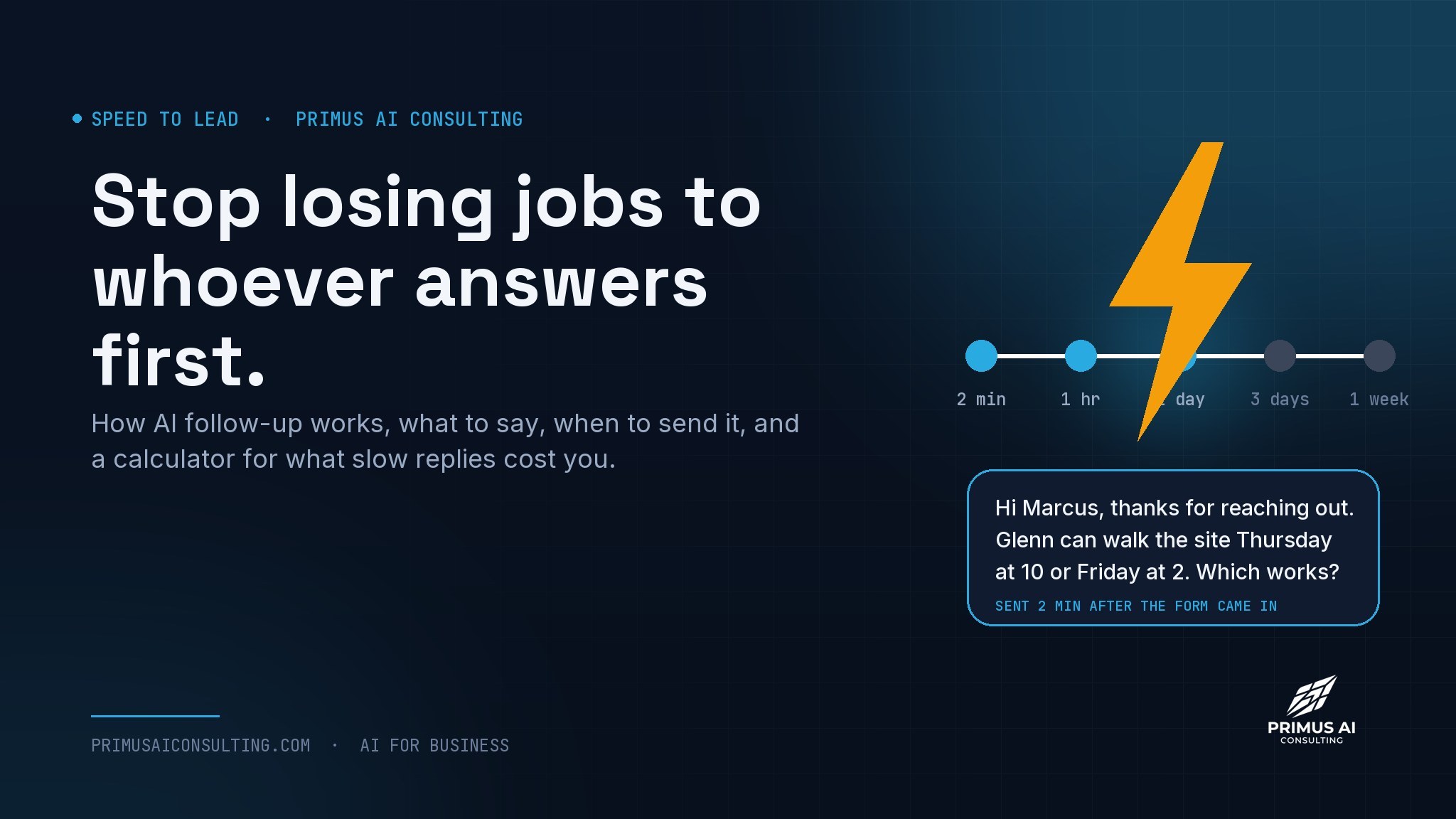
Five touches over about a week is the pattern that works for most service businesses. Enough to be present, not enough to be a pest. Each message has a different job, and the messages get shorter as they go.
- Two minutes: the acknowledgement text.
“Hi Marcus, this is Glenn at Primus. Got your note about the basement dehumidifier. Quick question so I can give you a straight answer: is it a finished basement or unfinished?” One question. It proves a person exists and it starts a conversation instead of a queue.
- One hour: the call.
A human calls. If it goes to voicemail, leave a ten-second message and send a text: “Just tried you. I can walk the site Thursday at 10 or Friday at 2. Either work?” Two real options beat “call me back.”
- Next day: something useful.
An email with one piece of information they can use whether or not they hire you: what the job typically involves, what to check first, what it usually costs in a range. Helpful reads as confident.
- Day three: the easy yes or no.
“Still want me to come take a look, or did you get it sorted?” Give them permission to say no. Half the time they say “still interested, been slammed,” and you are back in.
- Day seven: close the loop.
“I’ll assume the timing didn’t work out. If it comes back up, I’m a text away, and the ballpark I gave you holds through [month].” Then stop. A lead that resurfaces on its own is the best kind.
Sequence builder for your business
Pick your type of business and where the lead came from. You get five drafts with timing you can paste into your CRM, your phone, or your automation tool. Edit the brackets and change one line so it sounds like you.
Three levels of AI follow-up
How much of this should be automated depends on volume. Here is the honest progression we walk owners through.
| Level | What runs it | Right when | The catch |
|---|---|---|---|
| 1. The habit | A saved message on your phone, a prompt in your AI assistant for the emails, and a calendar reminder for touches three through five. | Under ten new leads a month, and you are the one answering anyway. | It depends entirely on you remembering. The week you get busy is the week it stops. |
| 2. The tools | Missed-call text-back on your phone system. A follow-up sequence in your CRM or field service platform, triggered when a lead is created. An AI answering service after hours. | Ten to fifty leads a month, with someone in the office who can own the setup. | Each tool only sees its own slice. The CRM does not know the phone rang; the phone does not know you already quoted them. Duplicate or tone-deaf messages creep in. |
| 3. The agent | One system that reads the form or the voicemail, checks your real calendar, texts the customer two genuine time options in your voice, logs the lead, and tells you what it did. It runs the sequence until a human takes over. | Fifty or more leads a month, several people touching leads, or leads that are expensive enough that losing one hurts. | It is a build, not a subscription, and it needs your real data, which is why we run it on hardware inside your building. Anything involving a price still waits for a human. |
Level three is what we build, and we tell owners plainly when they are not there yet. Most businesses should get level two working first; the tools are listed in our AI tools guide. If you want to see what level three looks like inside an actual day, this walkthrough follows an agent through one.
Rules that keep follow-up from backfiring
Automated follow-up can do damage if it is careless. These rules come from watching it go wrong.
- Get permission to text. US rules on business texting require consent. Your web form should say plainly that you may text them, and every system you use must honor “STOP.” If someone opts out, the sequence ends, no exceptions.
- Stop the instant they reply. Nothing reads as more automated than a “just checking in” text arriving an hour after the customer already answered. A reply has to halt the sequence and hand off to a person.
- Never quote a price by automation. Ranges in an email are fine. A number that sounds like a commitment is not. Anything with dollars waits for a human.
- Sign every message with a real name. “Glenn at Primus” gets replies. “The team” gets ignored.
- Five touches, then stop. The sequence has an end. Leads that get twelve messages leave one-star reviews.
- Do not text between 8 p.m. and 8 a.m. If the form comes in at 11 p.m., the acknowledgement can be an email, or the text can wait until morning. A midnight text feels like a machine because it is one.
- Read the replies every day. Automation creates conversations. Somebody has to be in them.
The four numbers to track
You cannot manage follow-up on feel. These four numbers fit on an index card, and most CRMs can produce them.
The first and last numbers are the ones that change fastest once follow-up is automated. The close rate moves more slowly, and it is the one the calculator above depends on, so track it honestly from the start.
Questions owners ask
Won’t customers be annoyed by automated follow-up?
They are annoyed by irrelevant, repetitive, or badly timed follow-up. A fast, specific first text with a real question is the opposite of that, and it is what the businesses winning the jobs are already doing. Follow the five-touch limit and the quiet-hours rule and complaints are rare.
Can AI actually call leads back for me?
Yes, AI phone agents exist and some are decent for taking a message and booking a time. We recommend caution: a bad AI phone call loses a lead faster than a slow human one. Text-first acknowledgement plus a human call within the hour is the safer combination for most small businesses right now.
What if I only get a handful of leads a month?
Then every one of them matters more, not less. Start with level one: a saved text, a saved prompt, and a reminder. The habit costs nothing, and you will feel the difference within a month.
Should follow-up come from me or from the office?
From a named person, whoever it is. For quotes over a certain size, the owner’s name gets better response rates because it signals the decision-maker is paying attention. The office can run the sequence; the signature can be yours.
How is this different from a CRM drip campaign?
A drip campaign sends the same emails to everyone on a schedule. Lead follow-up is a short, personal sequence tied to one specific request, that stops the moment the person replies. The tools overlap; the intent does not.
Losing leads you never see?
Bring one month of leads to a free 30-minute call. We will map where they go quiet and tell you whether a habit, a tool, or an agent is the right fix. If your current software already does it, we will show you the setting.
Keep reading